Friday, November 13, 2015

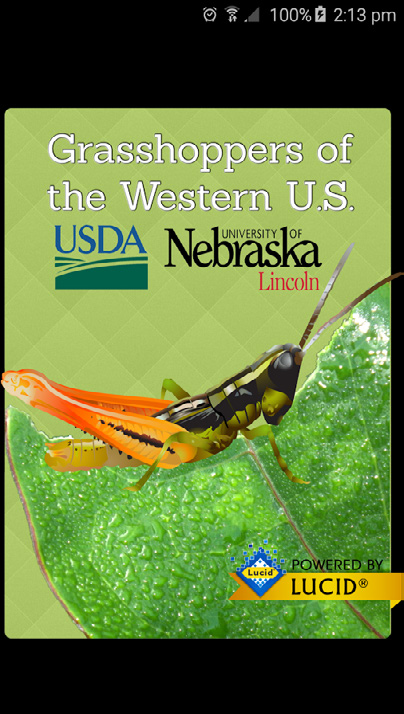
Grasshoppers of the Western U.S.

Need to identify a grasshopper in the Western U.S? Well now there’s an app for that.

The ITP team (USDA/APHIS) has released a new Lucid Mobile app, Grasshoppers of the Western U.S. The app was developed with the cooperation of Australia's Identic team based on ITP's recently released web-based tool, Grasshoppers of the Western U.S., Edition 4

Grasshoppers of the Western U.S. app has 'keys' to identify grasshoppers in adult and pre-adult stages. The keys setup to be user friendly for citizen scientists to expert entomologists.

76 species of adult grasshoppers are identifiable in the family Acrididae and one in the family of Romaleidae. 

Grasshoppers of the Western U.S. Lucid Mobile app is available at no cost for the iPhone, iPad, and Android mobile devices.

View ITP apps at the following sites. 

Search for New Director of Western IPM Center

The University of California's Agriculture and Natural Resources (UC ANR) department is in pursuit of filling the Director, Western Integrated Pest Management Center (Academic Coordinator III) position.

According to UC ANR, they are "seeking a Director to assume leadership for its Western IPM Center (WIPMC) within the UC Statewide IPM Program." The director will be responsible for the WIPMC staff as well as managing the operations of WIPMC.

Other responsibilities will include communication with WIPMC's Advisory and Steering Committees and collaboration with other agencies.

Minimum and Required Qualifications:
This position focuses on Integrated Pest Management.

  • A minimum of a Master’s Degree is required, though advanced degrees are preferred in an appropriate scientific discipline and professional background in any of the following pest management fields; entomology, plant pathology, weed science, nematology, or vertebrate pest management.
  • Experience leading or managing a program, obtaining and managing competitive grants; the ability to build new collaborative efforts among diverse stakeholders; staff supervision, and excellent interpersonal, organizational and communication skills are required. 
Preferred Qualifications:

  • Knowledge of the diverse agriculture in the Western U.S.; experience with federal grant sources. 

WIPMC is one fourth of the regional IPM centers focused on providing coordination of IPM programming. The remaining three regional centers are the Southern IPM Center (SIPMC), the Northeastern IPM Center (NEIPMC) and the North Central IPM Center (NCIPMC). 13 states and four Pacific Island territories are part of WIPMC.

For more information about the position or how to apply, please visit here or email Deziree Sutliff and refer to position #15-32.

Tuesday, November 10, 2015

A New 'Bugwood Images'


The Bugwood Center (The University of Georgia, Center for Invasive Species and Ecosystem Health) and ITP (USDA APHIS) announce the release of a significant update to the end-user interfaces for four of Bugwood’s image sites (http://images.bugwood.org/). Forestry Images, Insect Images, IPM Images, and Weed Images have a new look with added navigation and functionalities to support the use, sharing, and permission management of images. The update included ITP’s Plant Pest Image Node at Bugwood Images – a collection of over 23,000 images originating from ITP’s Identification Tools. Attached is a document highlighting a number of the updates that support the users of Bugwood Images. 
Terrence Walters, ITP Coordinator
Joe LaForest, Bugwood Center, Associate Director IPM and Forest Health

Tuesday, November 3, 2015

EAB strikes again!


The Animal and Plant Health Inspection Service (APHIS) has added North Carolina to the regulated area for Emerald Ash Borer (EAB). According to APHIS they are adding NC at the request of state, “in response to the detections of EAB in multiple counties throughout North Carolina.”

Regulated areas’ purpose is to prevent EAB from moving to other states. “Federal Order outlines specific conditions for the interstate movement of EAB-regulated articles from the quarantined areas in North Carolina”. These conditions include interstate movement of host wood for EAB and wood products from areas under quarantine. Firewood of all hardwood species, nursery stock, green lumber, waste, compost, and chips of ash species are in the category of wood products.


“The interstate movement of firewood from quarantined areas is an especially high-risk pathway for the spread of EAB.” APHIS is working with ‘state cooperators and foresters’ to help prevent the man-made spread of EAB, use controls (biological or otherwise) and increase the public’s awareness about the dangers of moving firewood.


States currently managing EAB with quarantined areas include Arkansas, Colorado, Georgia, Kansas, Louisiana, Maryland, Minnesota, New Hampshire, North Carolina, Tennessee, Wisconsin, and the District of Columbia. States entirely quarantined include Connecticut, Iowa, Kentucky, Massachusetts, Missouri, New York, Pennsylvania, Virginia and now North Carolina.

Monday, November 2, 2015

Watching species evolve, one after another


apple maggot (Rhagoletis pomonella) by Joseph Berger, Bugwood.org

The apple maggot (Rhagoletis pomonella), a fruit fly native to the U.S., is curious, as apples are not native to the U.S. Before the apple maggot started feeding on the apple in the 1850s, they would feed on native hawthorns and their life cycle was tied to the life cycle of the hawthorn.  Interestingly, there are wasp parasitoids which will infest larval apple maggot,s and so their life cycle is also tied into the same time frame.  As some of the apple maggots have displayed a preference for the apple trees over the hawthorns, very slowly, their life cycle has shifted to match the fruiting cycle of the apples.  Scientists have been watching the apple maggot and have seen how the feeding and mating habits have changed in the apple tree feeders, thus splitting the apple maggots into two different species based on their apple or hawthorn preferences.  As the life cycle of the maggots is changing, the parasitoid wasps are also splitting based on their hosts' preferences.  This supports the "sequential speciation" evolutionary process, stating that adaption and speciation doesn't occur independently and is more of a cascade of new species that arise as new niche opportunities are introduced.

apple maggot (Rhagoletis pomonella) by Whitney Cranshaw, Bugwood.org

Source Article: Caught in the act: New wasp species emerging
Apple Maggot Images: Rhagoletis pomonella

Tuesday, October 27, 2015

The University of Minnesota Extension is recruiting candidates for Extension Educator

The University of Minnesota Extension is recruiting candidates for Extension Educator - Aquatic Invasive Species Position at Andover or St. Cloud, Minnesota
For any questions about the job or application process please see the contact information at the end of the blog message.

ABOUT THIS POSITION
    The Extension Educator is responsible for developing, implementing, and evaluating educational programs that build local capacity for aquatic invasive species detection and response. These educational programs will provide training and tools to local governments, lake associations, AIS professionals, and citizens groups to prevent, detect, monitor, track, and control the establishment and spread of state-listed aquatic invasive species.
    To accomplish this, the AIS Extension Educator will, in coordination with MAISRC staff and researchers, Extension colleagues, and DNR staff: 1) develop and lead a statewide citizen science program aimed at tracking AIS population changes to inform management and research, 2) contribute to a statewide citizen science program for early detection of AIS; 3) contribute to other research-based AIS programs developed in response to state needs , 4) foster partnerships with state and local governments, lake associations, AIS professionals and citizens organizations, 5) provide programming to these partners to implement on-the-ground AIS prevention, detection, monitoring and control efforts, 6) assist with development of an online data repository for collecting and reporting data generated through these prevention, detection, monitoring and control efforts 7) assist in securing funding to sustain AIS programming efforts. Training and other program delivery will include using a variety of communication strategies appropriate for the intended target audience, including but not limited to workshops, classes, webcasts, social media, publications, mass media and community coalitions.
    The AIS Extension Educator will be affiliated with the Minnesota Aquatic Invasive Species Research Center (MAISRC) and act as a critical interface between local community groups, university scientists, and state natural resource agency managers. The AIS Extension Educator will coordinate with other Extension Educators and Specialists involved in AIS programming and with MAISRC researchers to operate as a team. The AIS Extension Educator will also coordinate communications efforts with MAISRC communications staff.

To Learn More About this JOB click here


TO APPY for Job Opening ID: 305531 you will need: 
  • Vitae
  • Cover letter
  • Transcripts for all college work (unofficial transcripts are acceptable at the application stage). 
  • Names and contact information for three professional references.
First click here to apply online and submit cover letter and resume

Click here to submit your transcript(s) and names and contact information online
  • Click on Employment
  • Click on “Using the Job Application System” (5th bullet on the left hand side of the screen)
  • Click on “My Activity” under “Application Activities”
  • From the drop box select: Transcripts or Reference Attachments
FOR QUESTIONS ABOUT YOUR APPLICATION CONTACT: Naaz Babvani, Extension Human Resources 260 Coffey Hall, 1420 Eckles Avenue, University of Minnesota St. Paul, MN 55108 Telephone: 612-624-3717 Fax: 612-624-7749 babva001@umn.edu
FOR QUESTIONS ABOUT THE POSITION CONTACT:
Faye Sleeper
Program Leader for the Extension Center of Food Agricultural and Natural Resources Sciences
Associate Director, University of Minnesota Water Resources Center
173 McNeal Hall, 1985 Buford Street
St. Paul, MN 55108
The University of Minnesota Extension Water Resource team's mission is to make a difference by connecting community needs and University resources to address Minnesota's critical water resource issues by providing and modeling effective education to ensure safe and sustainable water resources.
Phone: 612-624-3738       Email: fsleeper@umn.edu 

Saturday, October 24, 2015

America’s Longleaf Restoration Initiative

America’s Longleaf Restoration Initiative Longleaf Partnership Council: 2014 Range-wide Accomplishment Report

Key Overall Findings 

"The combined efforts of the many partners involved in longleaf restoration across the Southeast resulted in over 1.55 million acres of various on-the-ground longleaf restoration accomplishments. These restoration activities included tree planting, prescribed burning, mid-story treatments, invasive species control, native understory plant establishment, over-story treatments, and land acquisition/easements. Approximately 69% of the total accomplishments occurred within the SGAs. Approximately 61% of the overall 2014 accomplishments occurred in Florida (38%), Alabama (12%), and Georgia (11%), states which make up two-thirds of the current range-wide longleaf-dominated forest acreage. Most of the work on public lands (55%) occurred in Florida and Georgia and totaled over 658,000 acres. Restoration activities on private lands in Alabama and Georgia accounted for roughly one-half (175,000 acres) of the range-wide private lands total. Approximately 21% of the overall accomplishments occurred in the western range (Mississippi, Louisiana, and Texas), while 17% occurred in the eastern range (South Carolina, North Carolina, and Virginia)." To read the full Report:  2014 Range-wide Accomplishment Report