Showing posts with label Citizen Science. Show all posts

Monday, July 20, 2015

Bugwood goes to the Aquatic Plant Management Society Meeting

This is the first year that we have attended this meeting and it is definitely one we would like to go back to!  Over 100 people attended the meeting and represented academia, non-profit organizations, state agencies, federal agencies, industry, and other institutions.  The presentations were very interesting and we learned at lot.  Topics covered included: control/management methods, biology/physiology, monitoring technology, partnerships and programs, and interesting research.

Bugwood presented on the last day, covering the EDDMapS website, South Eastern Early Detection smartphone application, and covered the new push alert system.  The push alert system will send out alerts to user's smartphones about news relevant to the region or species included in the application.  Presentations given by other attendees were equally as interesting.

Did you know that when a crested floating heart (Nymphoides cristata) leaf is damaged or cut in half, it will grow roots and may produce daughter plants from the damaged leaf ?  This is information that will be important for planning management strategies in infested waterbodies.

crested floating heart (Nymphoides cristata) by Larry McCord, Santee Cooper, Bugwood.org

There were several presentations on grass carp (Ctenopharyngodon idella) movement in rivers and reservoirs.  Researchers will implant tracking devices in the grass carp and monitor their movement at key points to see where they will travel if they are introduced for invasive aquatic plants control.  Sterile grass carp, also called triploid grass carp, are often used in rivers to prevent them from reproducing.

grass carp (Ctenopharyngodon idella) by Florida Fish and Wildlife Conservation Commission Archive, Bugwood.org

In addition to the presentations, there was a large station with many species of aquatic weeds!  This is great for showing the variety of species that are an issue nationwide.
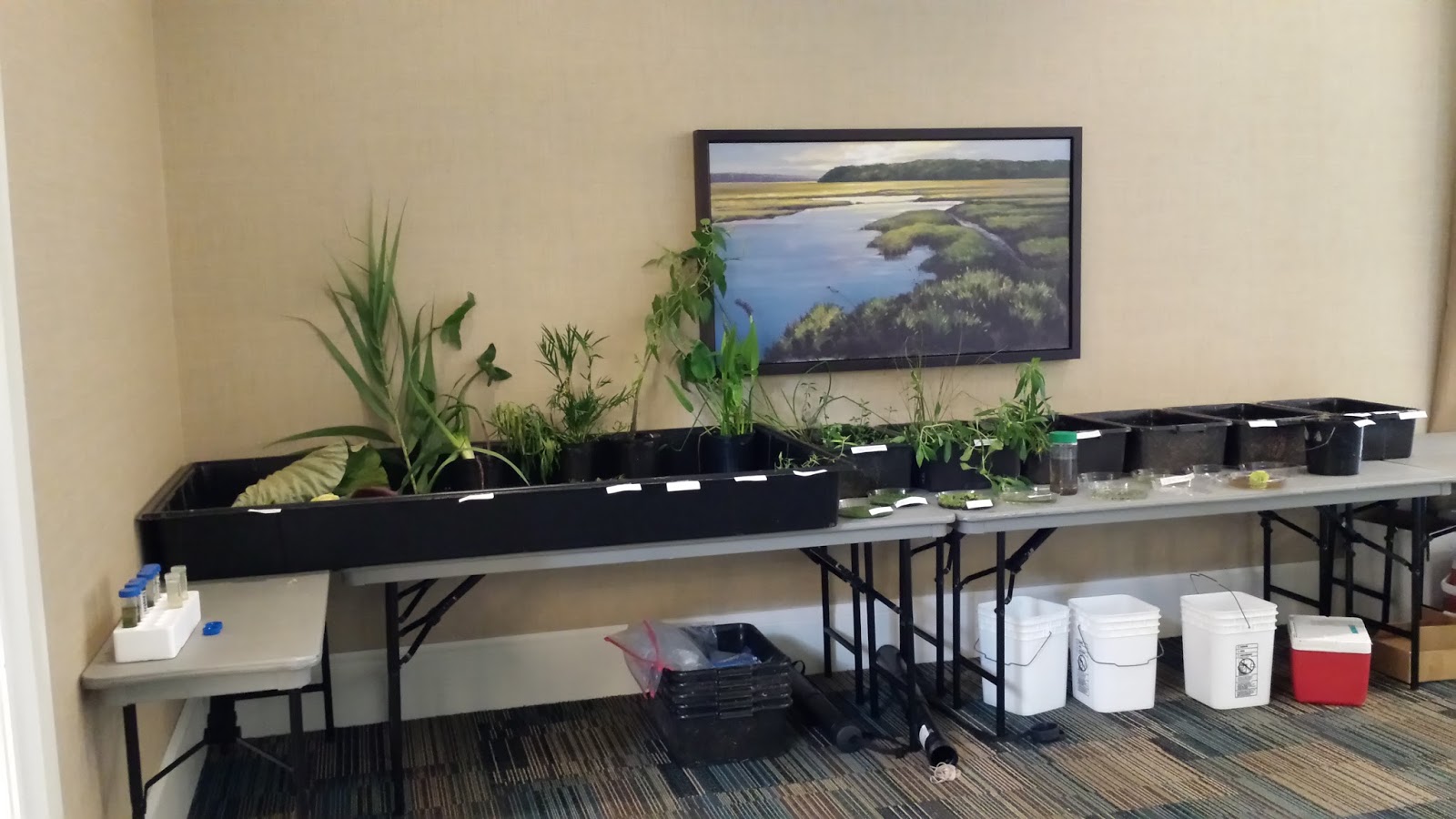
Aquatic weeds identification station by Rebekah D. Wallace

Shortly before the awards dinner, there was a duck race!

Aquatic Plant Management Society Meeting Duck Race by Rebekah D. Wallace
This was an interesting and educational meeting, so if you're in the aquatic plants field you should check it out!

Wednesday, May 6, 2015

Lionfish Tournament Northeast Florida, All You Can Catch!

We've post a few times about the invasive lionfish issue in Florida waters, so now's your chance to jump on the bandwagon and, if you're lucky, win a prize! The Northeast Florida Lionfish Blast is taking place from May 1-31 and who ever catches the most lionfish in two days of diving can win up to $1,000 and a sport watch.

lionfish (Pterois volitans) by U.S. Geological Survey Archive, U.S. Geological Survey, Bugwood.org
If you happen to have your smartphone or tablet and catch a lionfish, don't forget to report it!  Check out the IveGot1 application for iPhone and Android and don't forget to include a picture of the lionfish when you report!

Lionfish Tournament Takes Aim At Invasive Species
To learn more about this competition: Northeast Florida Lionfish Blast

Wednesday, March 4, 2015

Citizen Science for the Long View

Widely considered the Father of Phenology, Robert Marsham was very interested in documenting what he would call "The Indicators of Spring."  These are documentations of weather, animal, and plant activities and measurements which he and his descendants collected from 1736 to 1958. Of current interest for scientists studying the effects of climate change on the environment, they recorded the spring leafing and flowering time of the woodland plants on their estate in Norfolk.  This account is one of the longest running phenology records worldwide.

In a recent study, scientists from the University of Edinburgh and Biomathematics & Statistics Scotland used the data gathered by the Marsham family, and weather data gathered from the Central England temperature (CET) record, and evaluated the effect of temperature on fourteen species.  The study found that while all species will leaf and flower sooner after experiencing a warmer spring, a warm autumn will affect some early season leafing trees, such as birch, as compared to the later season leafing trees, like oak.  This effect may be due to certain species' chilling requirements and it is predicted that if seasonal temperatures continue to increase, oak may come into leafing earlier than birch over time.

river birch (Betula nigra) by T. Davis Sydnor, The Ohio State University, Bugwood.org


The unfortunate reality is that most data becomes lost or forgotten after the project ends.  Citizen science programs can be very useful in that new people can be continually added to the project and the data collecting can live on through new membership.  Citizen science programs similar to the work that the Marsham family did for so long exist in Project Budburst, Nature's Notebook, the National Phenology Network and many other projects.

For more on the study: Family log of spring's arrival helps predict climate-driven change
For more about Robert Marsham: Robert Marsham and Robert Marsham: The father of springtime records
For more information and a list of Citizen Science Programs: Scientific American - Citizen Science