Showing posts with label Technology. Show all posts

Wednesday, October 12, 2016

Thoughts from the International Congress of Entomology 2016

It has been a little over a week since we participated at the International Congress of Entomology 2016 in Orlando, FL and it was a great experience.  The Center for Invasive Species and Ecosystem Health hosted a booth in the Exhibit Hall for the week and we also participated in the Symposium: What Happens When Pest Occurrence Data is Shared: End of the World or New Horizons?

Image by: Rebekah D. Wallace
The conference had over 6,600 registered attendants and about half came from outside of the United States, representing 102 countries. It was a great opportunity to meet people we may not have another chance to otherwise.  In the six days that the Exhibit Hall was open and we were able to talk to over 260 people from at least 32 countries.  We talked at length with researchers from Nigeria, industry representatives from the U.K., academics from New Zealand, and more.  Some of the most interested attendees were the students who came from everywhere.  We were able to talk to people who had not heard of our program, those who only knew about one or two things that we do, and people who were avid supporters of Bugwood.

In working at the booth, we were able to make new connections with people who may be interested in using images from the Image Database in teaching and outreach.  Many were also interested in contributing images so that other researchers, teachers, students, etc. could have access to high-quality images.  We talked to people about EDDMapS and how we work with people in the invasive species community to map species occurrences across the U.S. and in Canada, and there were many people interested in potentially mapping in their own country, asking how we could work together to make that happen.  They learned about our smartphone apps and all of the types we have developed for reporting invasive species, identification, decision support, and more.  The teachers, and really anyone who has given a presentation, were interested in Bugwood Presents, our presentation database that allows you to upload, download, and embed presentations.

But, really, the greatest thing is when avid supporters would come to the booth and talk with other visitors about all of the things that we have done with them.  Countless projects, hours (and after-hours), travel time, webinars, e-mails, phone calls, and more with all of our partners is definitely worth it to hear how much people have been satisfied with the work we are doing.

Thank you to everyone who stopped by!

Friday, November 13, 2015

Lucid Mobile Apps Receive Updates

The team that brought you the Grasshoppers of the Western U.S. app has a new announcement. See below:

"In the fall of 2013, the ITP team (USDA/APHIS) released its first suite of Lucid Mobile apps. These apps were based on Lucid keys contained within 10 of ITP’s webbased identification tools (http://idtools.org/). The 10 apps were made available, via the Google Play Store, for Android mobile devices. In the spring of 2014, the 10 apps were made available for iPhones at the iTunes App Store.
In 2015, the Android and iOS apps received a signficant update to enhance the apps functionality for users.

Each of the 10 apps now has a custom-designed landing page to support easy access to the key(s) and the various types of content offered in the app. The apps have been updated to the latest Lucid Mobile Player, offering users a number of new features such as searchable/filterable lists and differences.

All 10 of the iOS apps are now universal apps, meaning that they are designed to run natively at a higher resolution on iPads. When you download the app from the iTunes App Store, you receive both the iPhone and iPad versions.

Lucid Mobile takes full advantage of all the conventions and functionalities to which mobile device users are accustomed, while supporting the valuable features of desktop Lucid keys. You can now carry Lucid keys with you into the field for screening and identification on your mobile devices without requiring internet access. To download ITP’s apps onto your iPhone, iPad, or Android mobile devices, or to update the apps you have previously downloaded, visit:


For questions or comments about ITP’s mobile apps,
contact the ITP team (itp@usda.gov)."

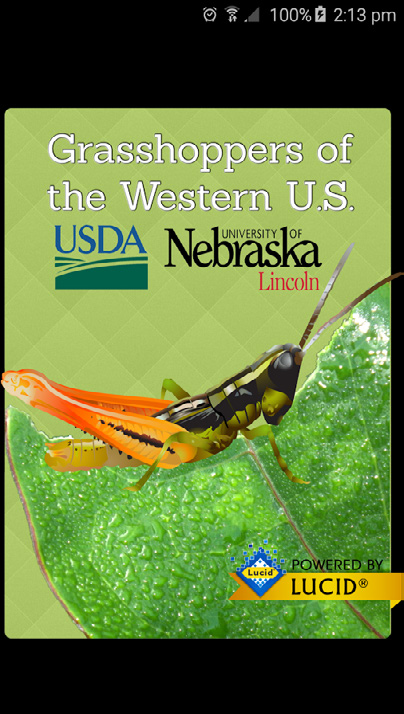
Grasshoppers of the Western U.S.

Need to identify a grasshopper in the Western U.S? Well now there’s an app for that.

The ITP team (USDA/APHIS) has released a new Lucid Mobile app, Grasshoppers of the Western U.S. The app was developed with the cooperation of Australia's Identic team based on ITP's recently released web-based tool, Grasshoppers of the Western U.S., Edition 4

Grasshoppers of the Western U.S. app has 'keys' to identify grasshoppers in adult and pre-adult stages. The keys setup to be user friendly for citizen scientists to expert entomologists.

76 species of adult grasshoppers are identifiable in the family Acrididae and one in the family of Romaleidae. 

Grasshoppers of the Western U.S. Lucid Mobile app is available at no cost for the iPhone, iPad, and Android mobile devices.

View ITP apps at the following sites. 


Tuesday, November 10, 2015

A New 'Bugwood Images'


The Bugwood Center (The University of Georgia, Center for Invasive Species and Ecosystem Health) and ITP (USDA APHIS) announce the release of a significant update to the end-user interfaces for four of Bugwood’s image sites (http://images.bugwood.org/). Forestry Images, Insect Images, IPM Images, and Weed Images have a new look with added navigation and functionalities to support the use, sharing, and permission management of images. The update included ITP’s Plant Pest Image Node at Bugwood Images – a collection of over 23,000 images originating from ITP’s Identification Tools. Attached is a document highlighting a number of the updates that support the users of Bugwood Images. 
Terrence Walters, ITP Coordinator
Joe LaForest, Bugwood Center, Associate Director IPM and Forest Health