Wednesday, December 2, 2015

Friends of Integrated Pest Management Award Nominations still open!

The Southern IPM Center still has it's Friends of IPM Award Nominations open.  The program recognizes outstanding work in IPM in the southern region. We have two kinds of awards: one for IPM professionals and one for graduate students.

Deadline for nominations is Friday, December 18, 2015.
You'll find the Calls for Nomination for these awards, along with cover forms, at http://projects.ipmcenters.org/Southern/public/ListRFAs.cfm . Click on the nomination call that you wish to use to get to the Call documents and the nomination form. You will be using our Proposal / Project Management System (PPMS) to submit your nominations this year, so please be sure to find the instructions for that in the Call for Nomination and follow the steps. 
Professional awards:
There are 6 categories of awards: 
  • Bright Idea (research-oriented or new idea)
  • IPM Implementer (on the ground)
  • IPM Educator (extension or teacher)
  • Pulling Together (group)
  • Future Leader (young professional)
  • Lifetime Achievement (seasoned professional). 
The award is open to anyone in the region demonstrating excellence in the field of IPM. In fact, they welcome the opportunity to recognize those outside of the university setting, such as growers, school IPM coordinators, teachers, etc. 
Award winners will be publicly recognized at an event of their choice.
The Call for Nominations for the professional awards is at http://bit.ly/1Pq4nPa .
Graduate Student awards:
The Friends of Southern IPM graduate student award will go to two graduate students: one Masters student and one Ph.D. student.
The graduate student award, in addition to a public presentation of the award, comes with a sizable monetary award. The winning Masters student receives $2,000, and the winning doctoral student receives $3,000. All winners—including in the professional category—must assist with a story about their work or conduct a webinar before receiving the financial award. Please read the Call for Nominations for more information.
This year, each department can nominate UP TO 3 Masters students and UP TO 3 Ph.D. students. Each department can submit up to six nominations, and universities can submit from more than one department (I.e., entomology, plant pathology, weed science, horticulture, etc. departments can submit from the same university).
The Call for Nominations for the graduate student awards is at http://bit.ly/1jZj8MY .
Nominations for both award programs consist of a cover form and a two-page written nomination. Additional materials may be submitted in support of the nomination but are not necessary. The bulk of the description and evidence of the person’s or group’s qualifications of the award should be in the two-page nomination, NOT in the additional materials.
Please share this notice with anyone you work with who may wish to nominate someone for either of these awards.

If you have any questions about either of these awards, or you have trouble navigating the PPMS system, please direct them to Henry Fadamiro at fadamhy@auburn.edu or 334-844-5098 or Rosemary Hallberg at rhallberg@sripmc.org or 919-513-8182.

Sunday, November 22, 2015

Western Weed Summit Takes Aim at Invasive Plants


Western Weed Summit Takes Aim at Invasive Plants

Finding a way to stop fire-prone cheatgrass and other invasive species is unavoidable if sagebrush ecosystems in the West are to remain viable for native plants and animals, experts say.

More than 200 federal and state land managers and scientists trying to figure out how to do that took part in the three-day 2015 Western Invasive Weed Summit that wrapped up Thursday in Boise.

Friday, November 20, 2015

Nine Wildlife Species Affected by Climate Change

A great article on the U.S. Department of the Interior blog on wildlife species affected by climate change. 

Here is what they say, "Climate change is one of the greatest challenges of our time. We are already seeing its effects with rising seas, catastrophic wildfires and water shortages. These changes are not only having a dramatic impact on diverse ecosystems but also on the wildlife that call these places home. Here are 9 species that are already being affected by climate change.

If we don’t act on climate now, this list is just the tip of the iceberg of what we can expect in years to come. Future generations shouldn’t just see these animals in history books -- we owe it to them to protect these creatures and their habitats."

Moose, Alces alces
Alfred Viola, Northeastern University, Bugwood.org

Friday, November 13, 2015

Lucid Mobile Apps Receive Updates

The team that brought you the Grasshoppers of the Western U.S. app has a new announcement. See below:

"In the fall of 2013, the ITP team (USDA/APHIS) released its first suite of Lucid Mobile apps. These apps were based on Lucid keys contained within 10 of ITP’s webbased identification tools (http://idtools.org/). The 10 apps were made available, via the Google Play Store, for Android mobile devices. In the spring of 2014, the 10 apps were made available for iPhones at the iTunes App Store.
In 2015, the Android and iOS apps received a signficant update to enhance the apps functionality for users.

Each of the 10 apps now has a custom-designed landing page to support easy access to the key(s) and the various types of content offered in the app. The apps have been updated to the latest Lucid Mobile Player, offering users a number of new features such as searchable/filterable lists and differences.

All 10 of the iOS apps are now universal apps, meaning that they are designed to run natively at a higher resolution on iPads. When you download the app from the iTunes App Store, you receive both the iPhone and iPad versions.

Lucid Mobile takes full advantage of all the conventions and functionalities to which mobile device users are accustomed, while supporting the valuable features of desktop Lucid keys. You can now carry Lucid keys with you into the field for screening and identification on your mobile devices without requiring internet access. To download ITP’s apps onto your iPhone, iPad, or Android mobile devices, or to update the apps you have previously downloaded, visit:


For questions or comments about ITP’s mobile apps,
contact the ITP team (itp@usda.gov)."

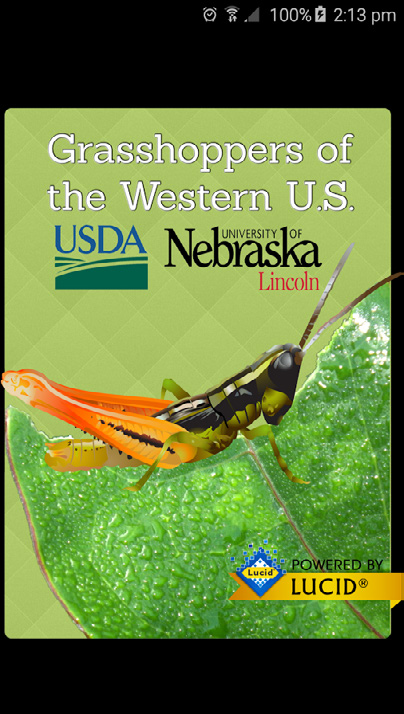
Grasshoppers of the Western U.S.

Need to identify a grasshopper in the Western U.S? Well now there’s an app for that.

The ITP team (USDA/APHIS) has released a new Lucid Mobile app, Grasshoppers of the Western U.S. The app was developed with the cooperation of Australia's Identic team based on ITP's recently released web-based tool, Grasshoppers of the Western U.S., Edition 4

Grasshoppers of the Western U.S. app has 'keys' to identify grasshoppers in adult and pre-adult stages. The keys setup to be user friendly for citizen scientists to expert entomologists.

76 species of adult grasshoppers are identifiable in the family Acrididae and one in the family of Romaleidae. 

Grasshoppers of the Western U.S. Lucid Mobile app is available at no cost for the iPhone, iPad, and Android mobile devices.

View ITP apps at the following sites. 


Search for New Director of Western IPM Center

The University of California's Agriculture and Natural Resources (UC ANR) department is in pursuit of filling the Director, Western Integrated Pest Management Center (Academic Coordinator III) position.

According to UC ANR, they are "seeking a Director to assume leadership for its Western IPM Center (WIPMC) within the UC Statewide IPM Program." The director will be responsible for the WIPMC staff as well as managing the operations of WIPMC.

Other responsibilities will include communication with WIPMC's Advisory and Steering Committees and collaboration with other agencies.

Minimum and Required Qualifications:
This position focuses on Integrated Pest Management.

  • A minimum of a Master’s Degree is required, though advanced degrees are preferred in an appropriate scientific discipline and professional background in any of the following pest management fields; entomology, plant pathology, weed science, nematology, or vertebrate pest management.
  • Experience leading or managing a program, obtaining and managing competitive grants; the ability to build new collaborative efforts among diverse stakeholders; staff supervision, and excellent interpersonal, organizational and communication skills are required. 
Preferred Qualifications:

  • Knowledge of the diverse agriculture in the Western U.S.; experience with federal grant sources. 

WIPMC is one fourth of the regional IPM centers focused on providing coordination of IPM programming. The remaining three regional centers are the Southern IPM Center (SIPMC), the Northeastern IPM Center (NEIPMC) and the North Central IPM Center (NCIPMC). 13 states and four Pacific Island territories are part of WIPMC.

For more information about the position or how to apply, please visit here or email Deziree Sutliff and refer to position #15-32.