Wednesday, March 6, 2013

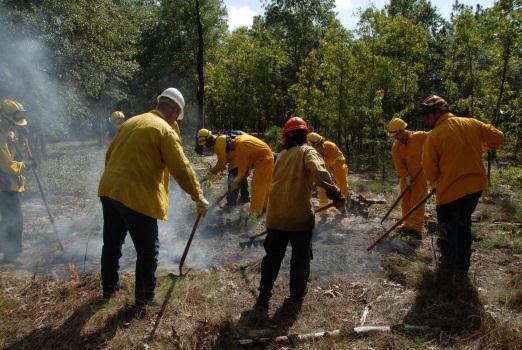
Basic Wildland Firefighter Training

Basic Wildland Firefighter Training
S130/190
Date: August 12-16, 2013 
Classroom Training: Waccasassa Forestry Center, Gainesville, Florida
Field Training: Ordway - Swisher Biological Station, Melrose, Florida
 
Tuition: $100 - Student registration
               $125 - General registration
 
This course prepares the individual to participate in wildland fire management/fire suppression activities as a Firefighter Type II qualified fire crew. 
What to bring:
Classroom training:
  • I-100 completion certificate
  • Lunch (lunch is only provided on Thursday, August 15 during the live fire exercise)
Field training:
  • 6 inch or higher leather boots
  • Leather gloves
  • PPE (optional)
For more information contact:
Natural Areas Training Academy
(850) 875-7153
nata@ifas.ufl.edu
http://wec.ufl.edu/nata 


Wednesday, February 27, 2013

White-Nose Syndrome in Bats

Pete Pattavina, a biologist with the U.S. Fish and Wildlife Service and a GA-EPPC (Georgia Exotic Pest Plant Council) board member, started cave surveys this week with GA DNR and the Georgia Museum of Natural History.

Nikki Castleberry from the Georgia Museum of Natural History also took part in the survey. She swabbed a tricolored bat (Perimyotis subflavus) for evidence of white-nose syndrome, caused by the fungus Geomyces destructans, most likely of European origin.  


Read more about White-Nose Syndrome in bats

Wednesday, February 13, 2013

Tree Health and Human Health Linked

From an article by the USDA Forest service: "Evidence is increasing from multiple scientific fields that exposure to the natural environment can improve human health. In a new study by the U.S. Forest Service, the presence of trees was associated with human health.
For Geoffrey Donovan, a research forester at the Forest Service’s Pacific Northwest Research Station, and his colleagues, the loss of 100 million trees in the eastern and midwestern United States was an unprecedented opportunity to study the impact of a major change in the natural environment on human health."

Tuesday, January 29, 2013

NISAW: March 3-8, 2013


March 3-8, 2013
 National Invasive Species Awareness Week is just around the corner. If you can not make it to Washington to attend the events planned there, then plan an event or project to recognize NISAW in your town or neighborhood.

Wednesday, January 16, 2013

Bargeron appointed to National Invasive Species Advisory Committee


Washington, D.C., - January 7, 2013.  Secretary of Interior, Ken Salazar, announced the appointment of Chuck Bargeron, Associate Director at The University of Georgia’s Center for Invasive Species and Ecosystem Health, to the Invasive Species Advisory Committee for the National Invasive Species Council (NISC).  The NISC members are the Secretaries and Administrators of 13 Federal departments and agencies who coordinate invasive species programs. The Council is co-chaired by the Secretaries of Commerce, Agriculture, and the Interior

The Invasive Species Advisory Committee (ISAC), comprised of 30 members appointed for 3-year terms, provides scientific and other input to the NISC regarding non-native plants and animals that annually cause $35 billion in economic and other hardship in the United States. The National Invasive Species Council was established by Presidential Executive Order 13112 in 1999 to ensure that Federal programs and activities to prevent and control invasive species are coordinated, effective and efficient. 

Bargeron has a Master’s Degree in Computer Science and has been with The University of Georgia for 14 years where he develops web applications, smartphone apps, databases and outreach publications.  These websites have received over 1 billion hits.  Bargeron was the Florida Exotic Pest Plant Council Advocate of the Year in 2008 and received the Mid-Atlantic Exotic Pest Plant Council Award in 2009. He is the current President of the National Association of Exotic Pest Plant Councils and Treasurer of the North American Invasive Species Network.  In 2012, as part the Everglades Cooperative Invasive Species Management Area, he received the U.S. Department of Interior – Partners in Conservation Award.  Bargeron has been an invited speaker at over 80 regional and national conferences and co-authored over 20 publications on invasive species issues.


The Center for Invasive Species & Ecosystem Health, located in Tifton, GA is a collaboration between the Warnell School of Forestry and Natural Resources and College of Agricultural and Environmental Sciences.  Its mission is to serve a lead role in development, consolidation and dissemination of information and programs focused on invasive species, forest health, natural resource and agricultural management.

See more about the National Invasive Species Council is available at: http://www.invasivespecies.gov; and about the Center for Invasive Species and Ecosystem Health at: http://www.bugwood.org/

Monday, January 14, 2013

Introducing the Ohio State University node of the Bugwood Image Database

Several institutions help to curate the Bugwood Image Database.  The Ohio State University has recently joined Colorado State University, Cornell University, and the University of Georgia in helping to build the Bugwood Image Database.  Their involvement will be unique as there are multiple departments within the university who will be collaborating including Entomology, Plant Pathology, Natural Resources, and Horticulture and Crop Sciences. We look forward to this new partnership and are excited to see what new innovations it will foster.

Sunday, January 13, 2013

Field Guide to the Identification of Japanese Stiltgrass

Field Guide to the Identification of Japanese Stiltgrass – with comparisons to other look-a-like species

Japanese stiltgrass (Microstegium vimineum) is an aggressive invader of forestlands throughout the eastern United States. Infestations can impact native species diversity, reduce wildlife habitat, and disrupt ecosystem functions. This publication provides descriptions and clear pictures of key characteristics as well as details on how to distinguish several common look-a-like species.

High-resolution version
Low-resolution version

Purchase copies from Alabama Cooperative Extension System