
Monday, November 16, 2015
Friday, November 13, 2015
Lucid Mobile Apps Receive Updates

"In the fall of 2013, the ITP team (USDA/APHIS) released its first suite of Lucid Mobile apps. These apps were based on Lucid keys contained within 10 of ITP’s webbased identification tools (http://idtools.org/). The 10 apps were made available, via the Google Play Store, for Android mobile devices. In the spring of 2014, the 10 apps were made available for iPhones at the iTunes App Store.
In 2015, the Android and iOS apps received a signficant update to enhance the apps functionality for users.
Each of the 10 apps now has a custom-designed landing page to support easy access to the key(s) and the various types of content offered in the app. The apps have been updated to the latest Lucid Mobile Player, offering users a number of new features such as searchable/filterable lists and differences.
All 10 of the iOS apps are now universal apps, meaning that they are designed to run natively at a higher resolution on iPads. When you download the app from the iTunes App Store, you receive both the iPhone and iPad versions.
Lucid Mobile takes full advantage of all the conventions and functionalities to which mobile device users are accustomed, while supporting the valuable features of desktop Lucid keys. You can now carry Lucid keys with you into the field for screening and identification on your mobile devices without requiring internet access. To download ITP’s apps onto your iPhone, iPad, or Android mobile devices, or to update the apps you have previously downloaded, visit:
For questions or comments about ITP’s mobile apps,
contact the ITP team (itp@usda.gov)."

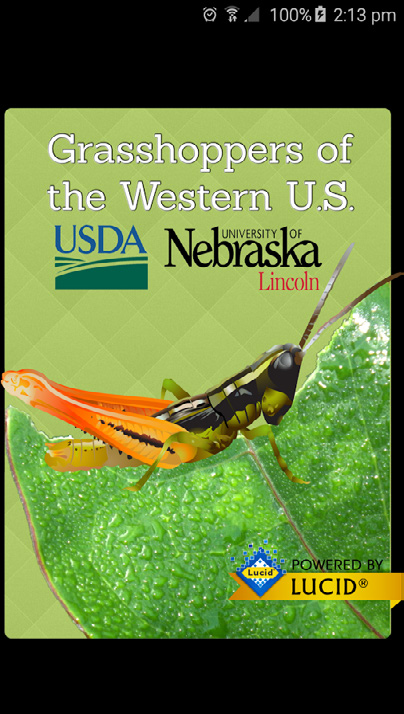
Grasshoppers of the Western U.S.
Need to identify a
grasshopper in the Western U.S? Well now there’s an app for that.
The ITP team
(USDA/APHIS) has released a new Lucid Mobile app, Grasshoppers of the
Western U.S. The app was developed with the cooperation of Australia's
Identic team based on ITP's recently released web-based tool, Grasshoppers
of the Western U.S., Edition 4.
Grasshoppers of the
Western U.S. app has 'keys' to
identify grasshoppers in adult and pre-adult stages. The keys setup to be user
friendly for citizen scientists to expert entomologists.
76 species of adult
grasshoppers are identifiable in the family Acrididae and one in the family of
Romaleidae.
Grasshoppers of the
Western U.S. Lucid Mobile app is available at no cost for the iPhone, iPad, and
Android mobile devices.
View ITP apps at the
following sites.
Search for New Director of Western IPM Center
The University of California's Agriculture and Natural Resources (UC ANR) department is in pursuit of filling the Director, Western Integrated Pest Management Center (Academic Coordinator III) position.
According to UC ANR, they are "seeking a Director to assume leadership for its Western IPM Center (WIPMC) within the UC Statewide IPM Program." The director will be responsible for the WIPMC staff as well as managing the operations of WIPMC.
Other responsibilities will include communication with WIPMC's Advisory and Steering Committees and collaboration with other agencies.
Minimum and Required Qualifications:
This position focuses on Integrated Pest Management.
WIPMC is one fourth of the regional IPM centers focused on providing coordination of IPM programming. The remaining three regional centers are the Southern IPM Center (SIPMC), the Northeastern IPM Center (NEIPMC) and the North Central IPM Center (NCIPMC). 13 states and four Pacific Island territories are part of WIPMC.
For more information about the position or how to apply, please visit here or email Deziree Sutliff and refer to position #15-32.
According to UC ANR, they are "seeking a Director to assume leadership for its Western IPM Center (WIPMC) within the UC Statewide IPM Program." The director will be responsible for the WIPMC staff as well as managing the operations of WIPMC.
Other responsibilities will include communication with WIPMC's Advisory and Steering Committees and collaboration with other agencies.
Minimum and Required Qualifications:
This position focuses on Integrated Pest Management.
- A minimum of a Master’s Degree is required, though advanced degrees are preferred in an appropriate scientific discipline and professional background in any of the following pest management fields; entomology, plant pathology, weed science, nematology, or vertebrate pest management.
- Experience leading or managing a program, obtaining and managing competitive grants; the ability to build new collaborative efforts among diverse stakeholders; staff supervision, and excellent interpersonal, organizational and communication skills are required.
- Knowledge of the diverse agriculture in the Western U.S.; experience with federal grant sources.
WIPMC is one fourth of the regional IPM centers focused on providing coordination of IPM programming. The remaining three regional centers are the Southern IPM Center (SIPMC), the Northeastern IPM Center (NEIPMC) and the North Central IPM Center (NCIPMC). 13 states and four Pacific Island territories are part of WIPMC.
For more information about the position or how to apply, please visit here or email Deziree Sutliff and refer to position #15-32.
Tuesday, November 10, 2015
A New 'Bugwood Images'

The Bugwood
Center (The University of Georgia, Center for Invasive Species and Ecosystem
Health) and ITP (USDA APHIS) announce the release of a significant update to
the end-user interfaces for four of Bugwood’s image sites (http://images.bugwood.org/). Forestry Images, Insect Images, IPM Images, and
Weed Images have a new look with added navigation and functionalities to
support the use, sharing, and permission management of images. The
update included ITP’s Plant Pest Image Node at Bugwood Images
– a collection of over 23,000 images originating from ITP’s Identification
Tools. Attached is a document highlighting a number of the
updates that support the users of Bugwood Images.
Terrence Walters, ITP Coordinator
Joe LaForest, Bugwood Center, Associate Director IPM and Forest Health
Tuesday, November 3, 2015
EAB strikes again!

The Animal and Plant Health Inspection Service (APHIS)
has added North Carolina to the regulated area for Emerald Ash Borer (EAB).
According to APHIS they are adding NC at the request of state, “in response to
the detections of EAB in multiple counties throughout North Carolina.”
Regulated areas’ purpose is to prevent EAB from moving to
other states. “Federal Order outlines specific
conditions for the interstate movement of EAB-regulated articles from the
quarantined areas in North Carolina”. These conditions include interstate
movement of host wood for EAB and wood products from areas under quarantine. Firewood
of all hardwood species, nursery stock, green lumber, waste, compost, and chips
of ash species are in the category of wood products.

“The interstate movement of
firewood from quarantined areas is an especially high-risk pathway for the
spread of EAB.” APHIS is working with ‘state cooperators and foresters’ to help
prevent the man-made spread of EAB, use controls (biological or otherwise) and increase
the public’s awareness about the dangers of moving firewood.
States currently managing EAB with quarantined areas include
Arkansas, Colorado, Georgia, Kansas, Louisiana, Maryland, Minnesota, New
Hampshire, North Carolina, Tennessee, Wisconsin, and the District of Columbia.
States entirely quarantined include Connecticut, Iowa, Kentucky, Massachusetts,
Missouri, New York, Pennsylvania, Virginia and now North Carolina.
Monday, November 2, 2015
Watching species evolve, one after another
 |
| apple maggot (Rhagoletis pomonella) by Joseph Berger, Bugwood.org |
The apple maggot (Rhagoletis pomonella), a fruit fly native to the U.S., is curious, as apples are not native to the U.S. Before the apple maggot started feeding on the apple in the 1850s, they would feed on native hawthorns and their life cycle was tied to the life cycle of the hawthorn. Interestingly, there are wasp parasitoids which will infest larval apple maggot,s and so their life cycle is also tied into the same time frame. As some of the apple maggots have displayed a preference for the apple trees over the hawthorns, very slowly, their life cycle has shifted to match the fruiting cycle of the apples. Scientists have been watching the apple maggot and have seen how the feeding and mating habits have changed in the apple tree feeders, thus splitting the apple maggots into two different species based on their apple or hawthorn preferences. As the life cycle of the maggots is changing, the parasitoid wasps are also splitting based on their hosts' preferences. This supports the "sequential speciation" evolutionary process, stating that adaption and speciation doesn't occur independently and is more of a cascade of new species that arise as new niche opportunities are introduced.
 |
| apple maggot (Rhagoletis pomonella) by Whitney Cranshaw, Bugwood.org |
Source Article: Caught in the act: New wasp species emerging
Apple Maggot Images: Rhagoletis pomonella
Subscribe to:
Posts (Atom)