
It grows on every continent except Antarctica and has earned a reputation as one of the worst weeds on earth. Now, according to U.S. Forest Service emeritus scientist Jim Miller, cogongrass (Imperata cylindrica) is one of the most threatening invasive species in the South.
Wednesday, June 19, 2013
Thursday, June 13, 2013
Worldwide Cooperation Fighting Invasive Species
Center Co-director, Dr. Keith Douce recently completed a trip to France and Switzerland where he met with and discussed ongoing programs and collaboration opportunities between The Center for Invasive Species and Ecosystem Health and:
- The leadership of The European and Mediterranean Plant Pest Organization (EPPO);
- Dr. Alain Roques and other members of The Forest Entomology Section of the National Institute for Agricultural Research (INRA), Station de Zoologie Forestière, Orléans, France;
- Dr. Marc Kenis, Head of Forestry and Ornamental Pest Research, and other CABI project leaders and associates at the CABI Delemont, Switzerland station.
While in Europe Dr. Douce had a chance to review the newly released, Insects and Diseases Damaging Trees and Shrubs of Europe which was edited by Milan Zùbrik (Head of Department of Forest Protection and Game Management, National Forest Centre, Zvolen, Slovak Republic); Andrej Kunca (Head of Forest Protection Service, Forest Research Institute, Banská Štiavnica, Slovak Republic); and György Csòka (Head of Forest Research Institute, Department of Forest Protection, Mátrafüred, Hungary).
Prominent forest protection experts from across Europe joined together to create this book: a comprehensive atlas to the world of insects and diseases damaging trees and shrubs in Europe.
The book is easy to use and the pests are arranged by the tree species on which they occur.
Information about each pests include: scientific name; common English name; life cycle; description of the life stages; significance (importance in Central Europe); and known distribution.
The book is richly illustrated by over 4,300 unique colour photographs (many of which were taken by the editors themselves), showing more than 1,100 species of insects and diseases causing damage to tree species and shrubs in Europe. Many of these and other images have been shared with Bugwood Images by the photographers.

Wednesday, June 12, 2013
The green menace strikes again! Human health effects of Emerald Ash Borer
 |
| Steven Valley, Oregon Department of Agriculture, Bugwood.org |
PBS NewsHour just published a piece on How Removing Trees Can Kill You as related to the loss of ash in Detroit, Michigan as a result of Emerald Ash Borer.
Geoffrey Donovan noted "Increased rates of death from cardiovascular and lower respiratory mortality in the counties with emerald ash borer. And interestingly, what we found was the effect got bigger the longer you had an infestation, which makes sense because it takes two to five years for a tree to die typically."
I've always touted the fact that trees in urban environments make it a better place to live. It takes something like this to make you appreciate just how important they can be!
Tuesday, May 21, 2013
Maps for the National Distribution and Trends of Pesticide Use from 1992-2009
Ever wonder what fungicides, insecticide or herbicides are used across the county? Have you been curious to know the levels of use? The US Geological Survey now has interactive maps to let you explore the trends of pesticide use from 1992 to 2009.
The new interactive national maps and trend graphs (http://water.usgs.gov/nawqa/pnsp/usage/maps) show the distribution of the agricultural use of 459 pesticides for each year during 1992-2009 for the entire conterminous U.S. The maps and supporting national database of county-level use estimates for each pesticide were developed by the U.S. Geological Survey for use in national and regional water-quality assessments.
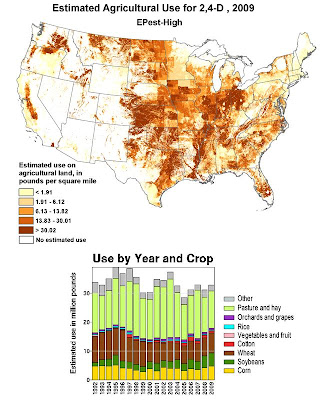
The new interactive national maps and trend graphs (http://water.usgs.gov/nawqa/pnsp/usage/maps) show the distribution of the agricultural use of 459 pesticides for each year during 1992-2009 for the entire conterminous U.S. The maps and supporting national database of county-level use estimates for each pesticide were developed by the U.S. Geological Survey for use in national and regional water-quality assessments.

Monday, May 13, 2013
Florida's Citrus Industry Battle's Invasive Foe
The invasive insect, Asian citrus psyllid, Diaphorina citri, carries and spreads a bacterial disease. The disease, called citrus greening, is being called the most serious threat the citrus industry has ever faced.
 |
| Asian citrus psyllid, Diaphorina citri Image: Jeffrey W. Lotz, Florida Department of Agriculture and Consumer Services, Bugwood.org |
Wednesday, May 8, 2013
Customs Inspectors - On the Front Lines
Dave Munday's recent article in The Post and Courier states, " The notorious big-headed ant was intercepted before it could gnaw its way through the Lowcountry.
The ants, along with a bunch of other insects, were found April 30 in the port of Charleston, crawling around in a container of aluminum scrap metal on a ship from Costa Rica, according to Steve Switzer, spokesman for the local customs office.
The big-headed ant is listed among 100 of the “World’s Worst” invaders, he said. It not only threatens native plants and other insects, it’s known to chew on irrigation pipes, telephone cables and electrical wires.'"
Read the entire article
The ants, along with a bunch of other insects, were found April 30 in the port of Charleston, crawling around in a container of aluminum scrap metal on a ship from Costa Rica, according to Steve Switzer, spokesman for the local customs office.
The big-headed ant is listed among 100 of the “World’s Worst” invaders, he said. It not only threatens native plants and other insects, it’s known to chew on irrigation pipes, telephone cables and electrical wires.'"
Read the entire article
 |
| bigheaded ant, Pheidole fervens Image by Eli Sarnat, Bugwood.org |
Wednesday, May 1, 2013
Nature's Rototillers: Feral Swine
Read the USDA blog, "Feral Swine: Ripping and Rooting Their Way across America", by Gail Keirn, APHIS Public Affairs Specialist.
More information on feral hogs across America:
 |
| Feral hogs, Sus scrofa Image: Vladimir Dinets, University of Miami, Bugwood.org |
Subscribe to:
Posts (Atom)